This walkthrough uses entirely synthetic footage built for demonstration. No real case material appears anywhere on this site. The goal is to show how the pipeline turns a single file into a finding that a person can verify by eye.
A 20 second clip from a fictional camera labelled CAM-01. It carries a burned-in clock in the lower strip and plays continuously at one frame per second. The footage looks ordinary.
Stage 1 hashes the file and locks the original. Every later stage reads the working copy only, and writes its own record. That is the chain of custody: if anyone questions whether the file changed during analysis, the intake hash answers it.
Stage 5 reads the burned-in clock out of each frame. Stage 6 also knows exactly how much footage has actually elapsed. Holding those two numbers side by side is the whole trick.
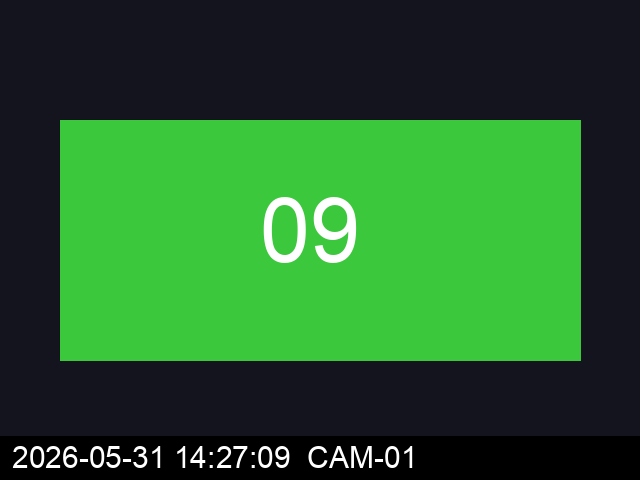
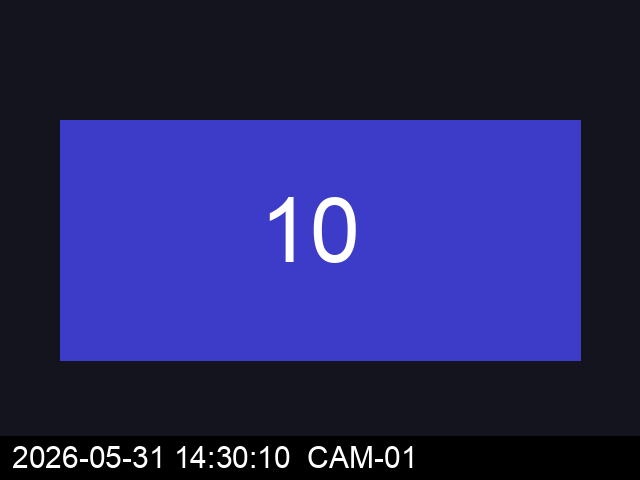
One frame of footage separates these two images. The on-screen clock between them advances by three minutes and one second. Real elapsed footage advanced by one second. A continuous recording cannot do that.
Stage 6 fits the on-screen clock against elapsed footage and reports the drift at each step. Nineteen of the twenty intervals line up to the second. One does not.
| Footage | On-screen clock | Elapsed | Clock step | Drift |
|---|---|---|---|---|
| 00:00:07 | 14:27:07 | +1.0 s | +1.0 s | 0.0 s |
| 00:00:08 | 14:27:08 | +1.0 s | +1.0 s | 0.0 s |
| 00:00:09 | 14:27:09 | +1.0 s | +1.0 s | 0.0 s |
| 00:00:10 | 14:30:10 | +1.0 s | +181.0 s | +180.0 s |
| 00:00:11 | 14:30:11 | +1.0 s | +1.0 s | 0.0 s |
| 00:00:12 | 14:30:12 | +1.0 s | +1.0 s | 0.0 s |
Three minutes of wall-clock time vanish between footage second 9 and second 10, with no corresponding footage. That is the signature of a paused recording or a removed segment.
The pipeline records this as a single, machine-readable finding with a severity and a recommended next step. The same object appears in the JSON output and in the final report.
One interval where the burned-in clock advanced differently from the elapsed footage. Strong indicator of paused recording or removed and inserted footage. Demand the full unedited original and metadata.
The clean version of the same footage, with a clock that ticks honestly, produces zero such findings. The test that matters for any detector is that it stays quiet when nothing is wrong. This one does.
Every engagement ends with one self-contained report and a PDF. It carries the findings, the exhibits they rest on, and the custody log, so the document stands on its own.